Refrigerator Repair
Sub-Zero Classic Alarm Keeps Chiming: Silence It, Then Read It
To silence a constantly chiming Sub-Zero Classic alarm, hold the ALARM and POWER keys together and let go of both in under 5 seconds. That buys 24 quiet hours, not a repair, so read the wrench icon before the chime comes back.
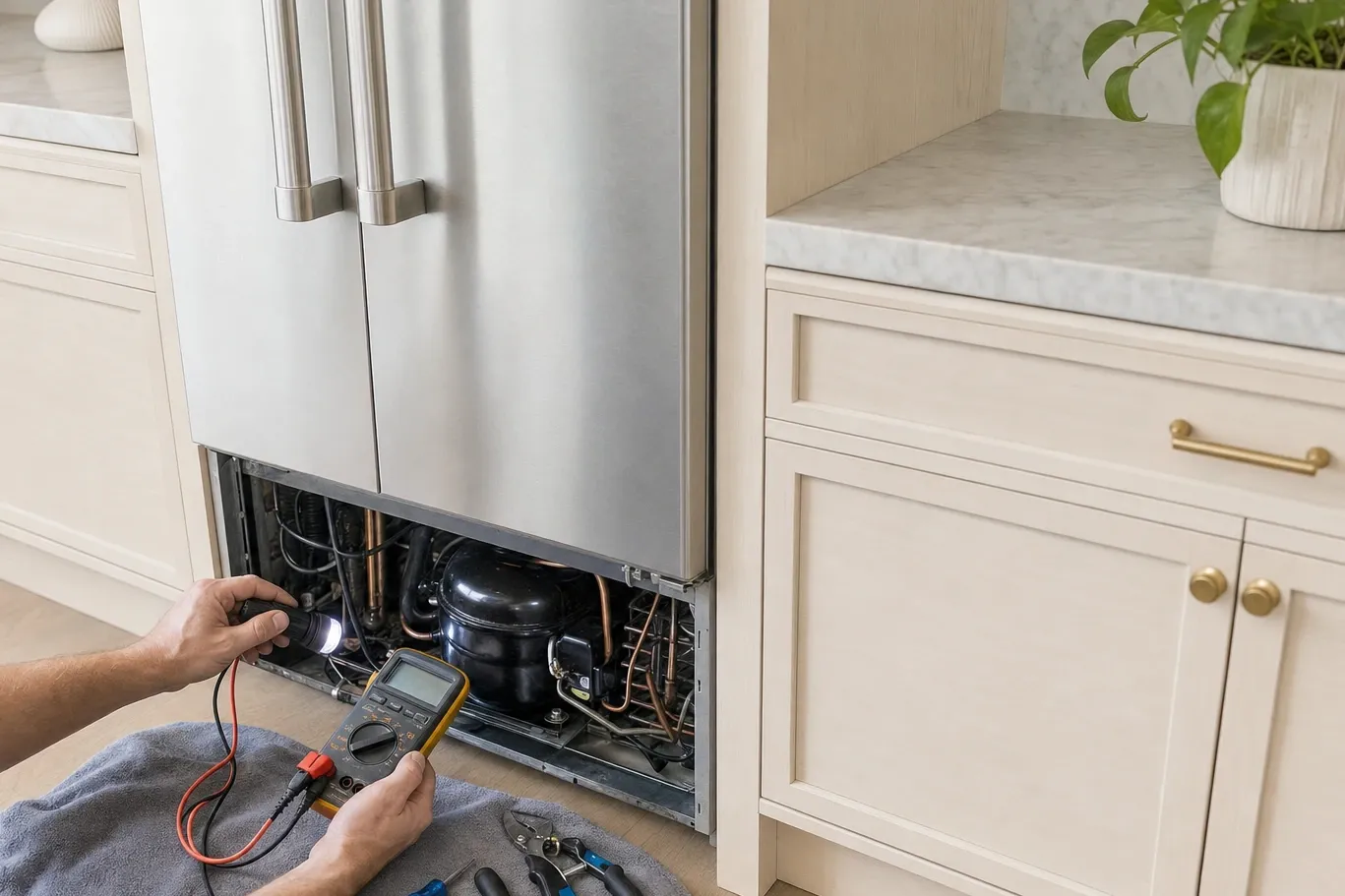
Press the ALARM and POWER keys on your Classic control panel at the same moment, hold them, and let go of both in under 5 seconds. The chime stops and the fault indicator drops out of sight for 24 hours. That is the whole procedure, and it is only a pause: the control has not forgotten the problem, it has simply agreed to stop announcing it for a day. Spend that day finding out what the alarm meant. In Phoenix, where long triple-digit summers and monsoon dust both make a condenser’s job harder, a complaint that starts small can become warm shelves before the next weekend.
Silencing the chime in four moves
Everything you need is on the panel itself. Work through it in this order:
- Open the refrigerator door far enough to see the panel and whatever it is showing.
- Before touching a key, record the display. Is the wrench lit, is it blinking or solid, and are there letters where a temperature normally sits? A quick phone photo is the easiest record.
- Press ALARM and POWER together and keep both held down.
- Release the pair at the same moment, well before 5 seconds have passed.
When it works, the kitchen goes quiet and the fault indicator is hidden. Do not mistake that quiet for a cure. The silence is designed to mask the indicator for 24 hours while the malfunction stays exactly where it was, which is why the chime returns on schedule when nothing has changed. Repeating the press every morning keeps the house peaceful, but it also buries a fault that may be getting worse in the background.
Flashing wrench versus steady wrench
The photo from step two is worth more than the silence. On Legacy Classic (BI) units, the service wrench tells you how serious the stored fault is, and a few other symbols on the same panel are worth knowing too.
| What the panel shows | What it means | Your next 24 hours |
|---|---|---|
| Wrench blinking, alarm chiming | A major error code was logged | Silence it, check food temperatures, book a diagnosis |
| Wrench solid, alarm chiming | A minor fault code that is not threatening temperatures | Silence it, watch the readings, schedule a visit |
| One ice cube blinking, no chime | The ice maker was shut off to prevent a flood | Check the water supply, then clear it |
| Sh r in place of a temperature | Showroom Mode, so the unit will not cool | Exit Showroom Mode |
A solid wrench still deserves attention, but there is no reason to empty the shelves tonight. A blinking wrench is different. Treat it as urgent: read the thermometer, keep the doors closed, and arrange a technician instead of silencing it a second time.
Three displays an owner can clear
Not every symbol on a Classic panel means a breakdown. Three of them come with a fix you can do yourself in a few minutes.
A single ice cube blinking without a chime
The panel is telling you the ice maker’s water valve was open for too long, so ice production has been shut down as a precaution against a flooded floor. Confirm that the supply to the refrigerator is turned on and that the line behind it is not kinked or dripping. Then press and hold Alarm until CFC shows on the display; the letters stand for Clear Fault Codes. If the icon keeps coming back, the valve or supply line needs testing. That kind of work typically runs $290–$830, with the firm figure given after diagnosis, and our page on Sub-Zero ice maker repair explains what the visit involves.
Sh r where a temperature belongs
Sh r is the panel’s shorthand for Showroom Mode, a demonstration setting in which the display responds normally but the compressor does no cooling. Getting out takes four presses. Turn the unit off with Power. Press and hold a matching Warmer and Colder pair. While still holding them, press Power. Then release all three keys together. A unit that is otherwise healthy should begin pulling its temperatures down from there.
Two dashes in one zone
A pair of dashes where a number should be means that zone has been switched off. It is the first thing to look at when the freezer stays cold and the refrigerator side does not. Reviving it is a two-step job: switch everything off with the Power key, then keep a finger on the Warmer key belonging to the dark zone as you tap Power once more.
EC50, Service flashing and a dusty condenser
When the panel shows EC50 along with a blinking Service light, the control is reporting that the refrigerator compressor has been running far longer than it should. Look at the temperatures before you do anything else. Readings near normal mean you can clean the condenser first and afterwards keep the bell key, which doubles as the door ajar alarm key, pressed for 15 seconds so the code clears. Readings that have climbed mean the reset should wait, because that case belongs with a technician.
On a Classic built-in the condenser lives behind the grille across the top of the cabinet. Shut the power off at the breaker, take the grille off, and run a vacuum’s soft brush gently over the coil in the direction the fins run, which keeps the thin metal from folding over. Some Sub-Zero panels request exactly this job by flashing the words Vacuum Condenser, a warning that the unit is running inefficiently or too warm, whether from coil dirt, a leaky door seal or a deeper unit problem.
Phoenix gives that coil plenty to catch. Monsoon dust storms force fine grit through every gap in a house, and a condenser drawing room air across its fins all year traps its share of it. A coated coil sheds heat badly, so the compressor stays on longer, which is precisely the condition EC50 flags. Our guide on why a Sub-Zero condenser struggles through a Phoenix summer looks at the seasonal side in more depth.
Keeping food safe while the alarm is quiet
Silencing the chime does nothing for the groceries, so put an inexpensive appliance thermometer on a middle shelf and a second one in the freezer. Federal food safety guidance asks for 40 degrees Fahrenheit or colder in the fresh food section and 0 degrees in the freezer. Open the doors as rarely as you can, because each opening lets in warm air and gives a struggling compressor more to recover from. If the refrigerator side has been above 40 degrees for two hours or more, move milk, meat and leftovers into a cooler with ice while you wait for help.
When the chime means a service visit
Some codes come with no owner fix at all. An EE code alongside the blinking service wrench means a temperature sensor, known as a thermistor, has failed. EE on the left side points to the freezer sensor, and EE on the right points to the refrigerator sensor. Sub-Zero offers no owner troubleshooting for it, and replacing a sensor usually falls between $300–$600 once the unit has been tested.
Book a technician when any of these apply:
- the wrench was blinking, or any wrench comes back once the 24 hours are up
- EC50 returns after a careful condenser cleaning, or the temperatures were high from the start
- EE appears on either side of the display
- the unit still will not cool after you have ruled out Showroom Mode and a disabled zone
Our diagnostic visit costs a flat $89; it includes travel plus a complete diagnosis, and we credit it against the repair bill when you give the go-ahead. Typical ranges after diagnosis include $330–$720 for an evaporator or condenser fan motor and $410–$1,000 for an electronic control board; the firm quote follows testing, never a guess over the phone. We work in homes across Desert Ridge, Encanto, Willo and Camelback East. Call (623) 323-5056 or use the booking button on this page, and see our Sub-Zero refrigerator repair service for what a visit covers.
Follow-ups
Does silencing the Sub-Zero Classic alarm clear the fault?
No, the two-key press only hides it. Pressing ALARM and POWER together and releasing them in under 5 seconds stops the chime and masks the fault indicator for 24 hours, but the control still holds the malfunction, so the alarm returns if the cause has not been dealt with.
Why is my Sub-Zero Classic not cooling while the display is lit?
Look for Sh r on the display first, because it means Showroom Mode is on, and in that mode the unit does not cool at all. Turn it off with Power, hold a matching Warmer and Colder pair, press Power while still holding them, then let go of all three. If the panel reads normally and the shelves stay warm, arrange a diagnosis.
Why does my Sub-Zero freezer stay cold while the refrigerator side warms up?
Check whether two dashes sit where the refrigerator temperature should be, since that shows the zone has been disabled. Switch the unit off with Power, then hold the refrigerator zone's Warmer key while pressing Power to bring it back. An EE code on the right side instead points to a failed refrigerator sensor, which needs a technician.
Is a steady wrench as urgent as a flashing one?
No, a solid wrench icon paired with chiming points to a minor logged fault that leaves your temperatures safe, whereas a blinking wrench signals a major error code. Both are worth a service visit, but the flashing one is the version to act on right away rather than silencing it again tomorrow.
What does the $89 service call cover?
The flat $89 visit pays for the trip and a full diagnosis of the unit, and it is credited toward the repair once you approve the work. You hear the firm quote after the technician has tested the refrigerator, before anything is replaced.