Freezer Repair
Freezer frost that comes straight back after monsoon week
Ice you clear by hand and find again a fortnight later is telling you something specific. This is how to tell a failed defrost circuit from a tired gasket or a blocked drain, and what each one costs you in the meantime.
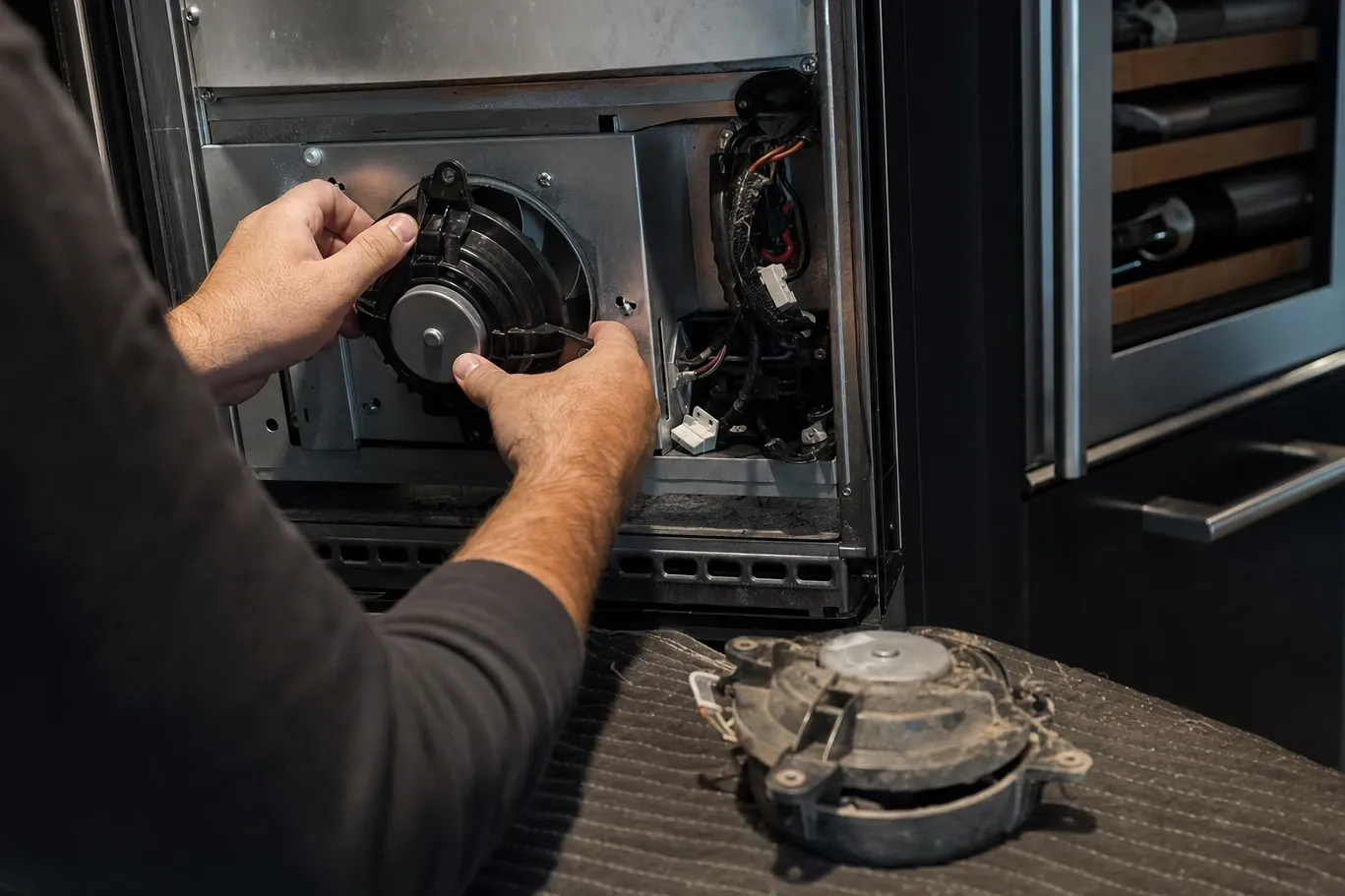
Phoenix freezers behave differently in monsoon season, and the calls we take in July and August are not the calls we take in March. The pattern is always the same: somebody spends an afternoon emptying the freezer, thawing a sheet of ice off the back wall with towels and a hair dryer, gets it working properly again — and then finds the same ice building two weeks later.
That returning ice is a useful symptom. It rules out the innocent explanations. A door left ajar once, or a warm bag of shopping put straight in, produces frost that the machine clears on its own over the following days. Ice that comes back on a schedule means the cycle designed to remove it is not doing its job, or moisture is arriving faster than the cycle can cope with.
Why humidity is the trigger here
A frost-free freezer runs a housekeeping loop against water vapour, and it never stops running it. Whatever air slips past the seal gives up its moisture to the coldest thing in the compartment — the evaporator, hidden behind the rear panel — and it freezes on contact. The answer to that is scheduled rather than clever: a heater strapped along the coil comes on a few times each day, warms it far enough to release its ice, and the meltwater leaves through a trough and down a tube. Then the coil goes back to collecting.
In dry desert air the amount of water in play is small, so a defrost system that is only working at half strength can still keep up and nobody notices. Then dew points climb thirty points in a week and that same half-working system falls behind immediately. This is why a fault that has actually been present since spring appears to start in July.
The practical consequence: if your freezer ices up every monsoon season and seems fine the rest of the year, it is not seasonal bad luck. It is a marginal defrost cycle being exposed.
Defrost circuit, gasket, or drain
Three different faults, three different signatures, and telling them apart is most of the diagnosis.
A failed defrost circuit puts ice evenly across the rear panel, thickest near the top, and the freezer creeps warm while the compressor runs more and more. As the coil packs with ice, air stops passing through it, so cooling drops even though the sealed system is perfectly healthy. Usually the heater has gone open circuit, sometimes the terminator or sensor, occasionally the control timing.
A tired gasket or a door out of square puts frost near the opening rather than the back: around the drawer rails, along the top of the door, at one corner. Look for a matching pattern of condensation and check whether the seal grips a sheet of paper all the way round. On a drawer model, ice that builds until the drawer will not close is nearly always this.
A blocked drain shows as ice at the bottom of the cabinet, water under baskets, or meltwater on the floor. The defrost heater is working — that is where the water came from — but the water cannot leave. It refreezes in the trough, the trough overflows, and the ice grows from the floor upward instead of from the back wall out.
Any of these can also be a second-order effect of the last one. A drain that freezes because the drain heater has failed produces ice that then blocks the air duct, which then looks like an air-side fault. Working out which came first is what stops you paying to replace parts that were only downstream of the actual problem.
What you can check yourself
Clear the ice first, properly, because you cannot see anything through it. Empty the freezer, switch it off at the breaker, and give it several hours with the door open and towels down. Do not chip at it with anything metal — the evaporator tubing behind that panel is soft aluminium, and puncturing it turns a straightforward repair into a very expensive one.
With the cabinet clear, look at where the ice actually was. Take a photograph before you clear it if you can; it is genuinely the most useful piece of information you can hand us.
Then test the seal. Trap a strip of paper in the shut door, tug it back out, and repeat that point by point right the way round the frame. Wherever the paper comes away without gripping, you have found a leak path. Follow it with your fingers along the gasket itself, hunting for rubber that has gone hard, split, or crushed flat — Phoenix heat ages these faster than the climates the parts were specified for.
Finally, find the drain outlet at the base of the compartment and check whether water poured slowly into the trough disappears or pools. Pooling is a blocked or frozen drain.
What we do on the visit
The rear panel comes off, which is where the honest answers live. We test the defrost heater for continuity, check the terminator or sensor against its specification rather than by eye, confirm the control is actually calling for defrost, and check the evaporator fan for a motor that turns but no longer moves air properly.
Then the drain path gets cleared and, on models that carry one, the drain heater clip is checked or replaced. A gasket that has failed the paper test gets replaced and the door adjusted until it pulls square, which matters as much as the seal itself.
Parts for all of this are stocked rather than special order, so most of these calls are one visit. What takes the extra half hour is watching the cabinet pull down afterwards to confirm the coil is frosting evenly again — because a repair that is not verified is only a guess with a receipt.
When to stop defrosting it by hand
If you have cleared the same ice twice, stop. The third defrost costs you another evening and another freezer full of food handled twice, and the underlying fault is still there. Two occurrences is enough information to diagnose from.
Call sooner than that if the freezer is holding above 10 degrees, if there is water on a wood floor, or if the drawer has stopped closing — that last one gets worse quickly, because a drawer held open by ice lets in the humid air that makes more ice.
Follow-ups
Is a thin layer of frost on the freezer wall normal?
A light bloom that comes and goes with door use is normal. A sheet you can chip, a drawer that will not close, or ice around the fan housing is not — those mean moisture is arriving faster than the defrost cycle can clear it.
Will emptying and switching the freezer off for a day fix it?
It clears the ice and buys a few weeks, which is worth doing if you are waiting on a visit. It does not repair a failed heater, sensor or drain, so the frost returns on the same schedule it did before.
Why does this happen more in July and August here?
Monsoon humidity. Every door opening pulls in air carrying far more water than dry desert air does, so any weakness in the defrost cycle or the door seal shows up as visible ice within days rather than months.